NFPA 704: The Complete Guide for Houston Businesses
The Emergency That Changed Everything
Picture this: It’s 2 a.m. at a chemical factory. A tank cracks. Liquid pours onto the floor. The alarm goes off. Workers get out. Fire trucks arrive in minutes. Firefighters run toward the spill, then stop. They need to know ONE thing: Is this water reactive? Will it blow up? Is it toxic? Will water make it worse?
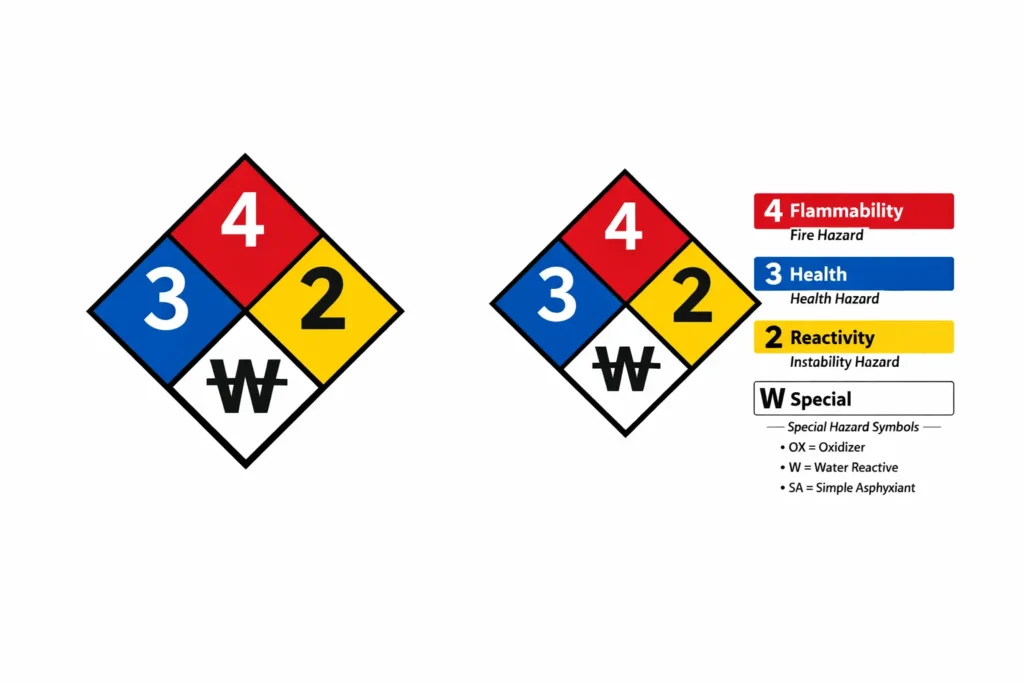
They look for the diamond. There it is. Red 4. Blue 3. Yellow 2. White: W.
In seconds, they get it. This stuff ignites at room temp. It’s poison. It goes boom when heated. And water makes it worse. They change tactics immediately. Dry stuff only. Full gear. Keep water away. No guessing. No delays. No improvising.
That’s what NFPA 704 does. It takes life-saving info and turns it into a simple visual language. Anyone can read it in an emergency.
Why This Matters (Especially in Houston)
Many of your businesses work with hazardous materials every single day. Refineries. Chemical plants. Distribution centers. Waste management facilities.
Some teams understand NFPA 704 completely. Others have heard of it but don’t really get how it works. Still others? They’re operating without proper labeling. That last group is playing with fire. Literally.
Here’s the thing: NFPA 704 isn’t just good practice. In Texas—especially Houston—it’s legally required. The Houston Fire Department actively enforces it. Non-compliance can mean citations. Fines. Even facility shutdown.
And beyond the legal stuff? Your workers deserve to know what they’re handling. Emergency responders deserve accurate info. Your facility deserves protection. That’s why proper business insurance for chemical operations is critical—but compliance prevents claims in the first place.
This guide covers everything you need to know. How to read the diamond. What each color means. How to set it up correctly. And specifically what Houston facilities need to understand.
What Is NFPA 704?
The National Fire Protection Association? They created this standard because firefighters need ONE thing: instant info about chemical hazards. Not product details. Not usage instructions. Just the dangers.
When a facility’s on fire, responders don’t have TIME to read Safety Data Sheets. They need to understand the threats in seconds. That’s what the fire diamond does. It answers four critical questions:
- How flammable is this?
- How toxic is it?
- Could it explode?
- Are there special dangers (water reactive, oxidizer, etc.)?
- Firefighters use this info to pick everything—what gear to wear, whether to use water, how to move in. Every decision depends on it.
Important note: NFPA 704 only tells you HOW to label. It doesn’t tell you WHEN to label. For that, you need to check local, state, and federal rules. Which vary depending on where you operate.
In Texas, fire codes reference NFPA standards. In Houston specifically, the fire code basically says, “If you’re storing hazardous chemicals, you’re using the fire diamond.” For authoritative guidance, check the official NFPA 704 standard documentation from the National Fire Protection Association.
The Diamond: Why It Looks This Way
You’ve probably seen these diamonds. They’re designed that way for a reason. The square rotated 45 degrees creates a diamond shape. It’s unmistakable. You can spot it from far away. Even in an emergency. Even in smoke or chaos.
The diamond splits into four equal sections. Each one shows a different type of hazard. Here’s the positioning—and firefighters memorize this: Clock position reference (seriously, responders use this):
- Red = 12 o’clock (top)
- Blue = 9 o’clock (left)
- Yellow = 3 o’clock (right)
- White = 6 o’clock (bottom)
Firefighters know this. They don’t think about it. They just look. “Blue on the left—that’s health hazard.” Boom. Instant info. Three sections have numbers. One has symbols. Simple. Fast. Saves lives.
The Numbers: 0 Through 4
Before we talk about colors, get the numbers. Three of the four sections use a 0-4 rating system:
- 0 = Minimal hazard
- 1 = Slight hazard
- 2 = Moderate hazard
- 3 = Serious hazard
- 4 = Severe hazard
That’s it. Low number? Less dangerous. High number? Extremely dangerous. Now let’s talk about what each color means.
The Four Colors Explained
RED: Flammability (Top – 12 o’clock)
Red tells you how easily something catches fire. Will water work? Or will this stuff burn hotter?
- Red 0: Will Not Burn Nothing will light this up. Ever. Water’s fine. Don’t worry about flames. Examples: Nitrogen, argon, inert gases (verified per NFPA standards)
- Red 1: Requires Significant Heat You’d need to heat this above 200°F to ignite it. For practical purposes? It’s non-flammable. Typical examples: Mineral oil, coconut oil, wax (Note: Specific ratings vary by product. Always verify using your chemical’s Safety Data Sheet.)
- Red 2: Moderate Heat Required Flashpoint between 100°F and 200°F. Keep it away from heat. But it’s not a tinderbox. Common examples include diesel fuel and kerosene, though flashpoint varies by grade and formulation. (Always verify your specific product’s SDS Section 16 for the exact NFPA 704 rating.)
- Red 3: Ignites at Room Temperature Flashpoint between 73°F and 100°F. This is where things get serious. Gasoline? Red 3. Examples: Acetone, gasoline, paint thinner (ratings based on typical formulations; verify against your SDS)
- Red 4: Ignites Easily at Room Temperature Flashpoint below 73°F. This vaporizes at normal temps and burns readily. Hydrogen? Red 4. Examples: Ether, hydrogen, propane (typical examples; always consult SDS Section 16 for your specific chemical)
⚠️ CRITICAL: How to Find Accurate NFPA 704 Ratings
Do NOT guess or use these examples as gospel truth. Every chemical’s rating must be verified:
Step 1: Get your chemical’s Safety Data Sheet (SDS)
Step 2: Look at SDS Section 16 — this contains NFPA 704 ratings
Step 3: Compare the numbers to the flammability scale above
Important: Do NOT use the hazard category numbers from SDS Section 2 (GHS Hazard Classification) as your NFPA 704 rating. They use a different system:
GHS: 1 = most hazardous, 4 = least hazardous (OPPOSITE of NFPA)
NFPA 704: 0 = least hazardous, 4 = most hazardous
If your SDS doesn’t list NFPA 704 in Section 16, contact your chemical supplier to request it.
BLUE: Health Hazard (Left – 9 o’clock)
Blue shows what happens if someone breathes it, touches it, or swallows it.
- Blue 0: No Health Hazard Not toxic. Not irritating. No precautions needed. Examples: Salt, sugar, water
- Blue 1: Minor Effects Possible Maybe some irritation. Some minor damage. Basic gloves or a simple mask? That’s enough. Examples: Most common household chemicals
- Blue 2: Serious If You’re Exposed for a While Work with it for hours without protection? You’re going to have problems. Proper air flow and respirator? Essential. Examples: Many irritant gases
- Blue 3: Brief Exposure Causes Serious Damage Even short contact is dangerous. Full protective gear required. Workers shouldn’t touch this without serious care. Examples: Highly toxic chemicals
- Blue 4: Extreme Danger Even seconds of exposure can kill. This is medical crisis territory. Maximum protection required. Examples: Certain cyanides, extremely toxic agents
YELLOW: Reactivity (Right – 3 o’clock)
Yellow is about instability. Does this stuff react violently? Could it blow up? Will it react badly with water?
- Yellow 0: Stable Won’t react unexpectedly. You can mix it with other stuff. No surprises. Examples: Most industrial chemicals
- Yellow 1: Normally Stable, But Watch Out Elevated heat or pressure makes it unstable. Keep it cool. Don’t increase pressure. Examples: Some peroxides
- Yellow 2: Becomes Violent When Heated Heat + this chemical = big reaction. Also? Reacts badly with water. Keep it away from water. Examples: Some metal hydrides
- Yellow 3: Might Explode Under Stress Shock? Severe impact? Could trigger it. Water contact? Explosion. Handle very carefully. Examples: Certain unstable compounds
- Yellow 4: Might Explode on Its Own No trigger needed. No heat required. This material is just inherently unstable. Requires special storage and expert care. Examples: Nitroglycerin, other extremely unstable compounds
Reading the Diamond: Real Examples
Okay. So you understand each color and number. How does it work when you see a diamond with all four sections? Let’s use real situations.
Scenario 1: Red 2 | Blue 1 | Yellow 1 | White: (empty)
- Red 2: Moderate flammability (needs heat to ignite)
- Blue 1: Minor health hazard (irritation possible)
- Yellow 1: Normally stable, but elevated temps cause problems
- White: No special hazards
- What this means: This material will burn if you heat it enough. It might irritate skin or cause coughing. Don’t expose it to high temps. Water’s fine. Workers need basic PPE (gloves, maybe a mask).
- Example: Diesel fuel or kerosene
Scenario 2: Red 4 | Blue 2 | Yellow 1 | White: (empty)
- Red 4: Severe flammability (ignites at room temp)
- Blue 2: Moderate health hazard (intense or long exposure is bad)
- Yellow 1: Normally stable
- White: No special hazards
- What this means: This ignites easily at room temp. You need serious fire protection. Workers exposed for long periods need protection. It’s chemically stable though. Water’s safe.
- Example: Gasoline, acetone
Scenario 3: Red 3 | Blue 3 | Yellow 2 | White: W
- Red 3: Ignites at room temp (flashpoint 73-100°F)
- Blue 3: Brief exposure causes serious damage
- Yellow 2: Gets violent when heated, reacts with water
- White: W = Water reactive
- What this means: Don’t use water. This ignites at room temp. It’s toxic—brief contact is dangerous. Heat makes it violent. This requires fireproof storage, full protective gear, no water. Emergency responders cannot use water. This is extremely hazardous.
- Example: Sodium metal, certain metal compounds
Scenario 4: Red 0 | Blue 4 | Yellow 0 | White: SA
- Red 0: Won’t burn
- Blue 4: Extremely toxic—brief exposure may cause death
- Yellow 0: Chemically stable
- White: SA = Simple asphyxiant gas
- What this means: Not flammable. Not chemically reactive. But it’s deadly toxic. Maximum respiratory protection required. This is an extreme hazard despite low red and yellow ratings.
- Example: Argon, nitrogen, helium (in concentrated form)
The White Section: Symbols Matter
Here’s where it gets specific. The white section doesn’t use numbers. It uses symbols. But—and this is important—only three symbols are officially authorized.
Authorized Symbols (Use Only These)
OX – Oxidizer This material speeds up combustion. It doesn’t blow up itself, but it makes things burn hotter and faster. Combine it with flammable stuff? That’s when things get dangerous. Chlorine? OX. Bleach? OX. Peroxide? OX. Firefighters see OX and they know: “This will accelerate fire. Standard fire suppression may not work. Special tactics needed.”
SA – Simple Asphyxiant Gas
This gas displaces oxygen in the air. Breathe it? You suffocate. But only certain gases get this label.
The primary simple asphyxiant gases are:
Argon
Helium
Krypton
Neon
Nitrogen
Xenon
Carbon dioxide can also function as a simple asphyxiant in industrial applications where it displaces oxygen (such as inert gas storage or cryogenic use). However, at higher concentrations, CO₂ has additional toxic effects beyond simple asphyxiation, so its classification depends on the specific use and concentration.
Why this distinction matters: These gases work by displacing oxygen without causing direct toxic effects on the body. This is different from chemical asphyxiants like carbon monoxide, which actively interferes with oxygen transport in the bloodstream.
To determine if the SA symbol applies to YOUR materials: Check your Safety Data Sheet (SDS) Section 16 for the NFPA 704 rating, or consult OSHA’s guidance on asphyxiant classification for your specific application. When in doubt, contact your chemical supplier or local fire department.
W with Strike-Through – Water Reactive This material reacts dangerously with water. Sometimes combustion. Sometimes explosions. Sometimes toxic gas generation. Sodium? Drop it in water? Combustion. Calcium carbide? Water contact? Generates acetylene gas (extremely flammable). Firefighters see W and they understand immediately: “Don’t use water. This will make it worse.”
Non-Authorized Symbols (Don’t Use These)
You’ll see other symbols sometimes. ACID. COR. ALK. Radioactivity symbols. Biohazard symbols. These aren’t official. Here’s why that’s a problem: Firefighters train extensively on OX, SA, and W. Those three symbols? They understand instantly. Unauthorized symbols? They create confusion in emergencies. Responders pause. They try to interpret. Precious seconds tick by. Also, many unauthorized symbols are redundant. Corrosive hazards? Those show up in the blue rating (health hazard). Acidic/alkaline? That overlaps with health info too.
Bottom line: Stick with the three authorized symbols. If your material has other hazards, put that info in Safety Data Sheets. Don’t clutter the diamond with unofficial symbols.
Legal Requirements: Know What Your Facility Needs
National Level
NFPA 704 is voluntary. OSHA doesn’t mandate it. But OSHA requires hazard communication. Many facilities use NFPA 704 as their hazard communication method. You’ll use NFPA 704 if:
- Your facility chooses to use it
- Local or state rules require it
- Your industry standard requires it
- Texas Level
Texas adopts fire safety standards through the Texas Fire Code (TFC). The TFC references NFPA standards for hazardous materials. Under Texas Fire Code:
- Facilities storing hazardous materials must display appropriate warning signs
- The NFPA 704 fire diamond is the standard warning system
- Placement and sizing follow NFPA 704 guidance
- All entry points where firefighters could access the facility require signage
Houston Level (This Is the Big One)
Houston operates under a fire code that reflects its massive chemical and refining industry. The Houston Fire Department actively enforces NFPA 704 compliance. Especially in the industrial corridor—the Ship Channel area with all the refineries and chemical plants.
Houston inspectors look for:
- Presence and accuracy of diamonds
- Placement at all entry points
- Size and legibility
- Accuracy compared to facility inventory
- Maintenance condition
- Non-compliance results in:
- Citations from Houston Fire Department
- Orders to correct violations
- Fines
- Temporary facility closure (in severe cases)
The Ship Channel alone contains dozens of chemical facilities, refineries, petrochemical operations. Compliance is strictly enforced. Beyond legal compliance, your facility’s physical assets need protection. General liability coverage protects you against chemical-related incidents. And proper business property insurance covers chemical storage facilities, equipment, and inventory from fire and hazmat incidents.
Where to Place Diamonds
Every entry point where firefighters might access the facility. This means:
- Main building entrance
- Side and rear doors
- Loading dock entrances
- Roof access points
- Emergency exits (if they lead to chemical areas)
- Roof vents that might access chemical storage
- The principle is simple: Firefighters should see the diamond before they enter. So they can assess hazards and adjust tactics.
- Sizing
There’s no single size fits all. Size depends on viewing distance.
- Room-level labeling: 2-4 inch diamonds (visible from 5-10 feet)
- Building-level labeling: 10-14 inch diamonds (visible from 30+ feet)
- Large facility labeling: 14-30 inch diamonds (visible from 50+ feet)
Calculate the distance from which firefighters will first see the sign. Then choose a size that’s legible from that distance. NFPA 704 provides specific guidance for this.
Practical Implementation: 7 Steps to Compliance
Step 1: Audit Your Chemical Inventory List every hazardous material.
- Chemical name (not the brand name)
- Storage location
- Container types and sizes
- How it’s used
- Any special handling needs Then find the Safety Data Sheet (SDS) for each chemical. Manufacturers provide these. The SDS contains all hazard info you need.
Step 2: Get the NFPA Ratings For each chemical, find the NFPA ratings in the SDS:
- Blue rating (health hazard)
- Red rating (flammability)
- Yellow rating (reactivity)
- White symbols (special hazards) Don’t guess. Don’t estimate. Use the manufacturer’s info. Note: If you’re storing a mixture (chemicals combined together), you need the rating for the mixture itself. Not the individual parts. Ask the manufacturer if unsure.
Step 3: Create or Order Your Diamonds Three options:
- Option A: Buy pre-made diamonds. Safety suppliers like ComplianceSigns or Grainger stock standard ratings in multiple sizes. Quick. Professional. Consistent.
- Option B: Custom order. For non-standard combinations, order custom diamonds from suppliers. You specify ratings. They produce the diamond.
- Option C: Create them yourself. Some facilities make diamonds using vinyl decals or outdoor paint. Works if you have the capability and ensure quality.
Step 4: Install at Entry Points Install diamonds at all locations where NFPA 704 is required: Facility level: Main entrance, All personnel access doors, Emergency exits leading to chemical areas, Roof access points, Loading dock entrances. Within the facility: Individual chemical storage containers, Storage tanks, Warehouse walls near chemical storage, Doors leading to chemical storage rooms.
Step 5: Determine Sizing How far away will firefighters first see this sign? Measure the distance. Check NFPA 704 sizing guidance. Choose appropriate diamond size. Make sure it’s legible. A diamond you can’t read is worse than no diamond.
Step 6: Maintain Your Diamonds Diamonds fade. They get damaged. They become illegible. Set up maintenance:
- Check all diamonds every 3 months
- Replace any that fade or get damaged
- Update when chemicals change
- Keep records of maintenance
Step 7: Notify Emergency Responders Call your local fire department. Tell them:
- You have hazardous materials on-site
- Here’s our chemical inventory
- Can we give you a facility tour?
- Here’s our NFPA 704 labeling Building relationships with responders matters. They’ll use your diamonds in emergencies. Accurate info saves lives.
Common Mistakes (Don’t Make These)
- Mistake 1: Using non-authorized white symbols ❌ ACID, COR, ALK symbols in white section ✅ Use only OX, SA, W (with strike-through)
- Mistake 2: Ratings based on guessing ❌ “This is probably a Red-3” ✅ Check the Safety Data Sheet for exact ratings
- Mistake 3: Faded or illegible diamonds ❌ Diamond exists but can’t be read ✅ Replace diamonds that fade or deteriorate
- Mistake 4: Missing entry points ❌ Diamond on main door only ✅ Every potential firefighter access point needs a diamond
- Mistake 5: Diamonds placed where they can’t be seen ❌ Behind vegetation, equipment, or vehicles ✅ Clear, visible placement at eye level
- Mistake 6: Outdated chemical info ❌ Diamond reflects old inventory ✅ Update diamonds when chemicals change
Houston-Specific Realities
Why Houston Matters So Much
Houston’s economy depends on chemicals. The petrochemical industry is massive here. The Ship Channel has petroleum refineries, chemical manufacturing plants, petrochemical production facilities, chemical distribution centers, and waste management operations. NFPA 704 compliance isn’t optional in this environment. It’s essential for worker safety, emergency response coordination, insurance requirements, and legal compliance.
Houston Fire Department Enforcement
They actively inspect facilities in the industrial corridor. They look for:
- Presence and accuracy of NFPA 704 diamonds
- Placement at all entry points
- Size and legibility
- Accuracy compared to facility inventory
- Maintenance condition
Non-compliance gets you: Citations from HFD, orders to correct violations, fines, and potential temporary facility closure.
Texas Weather Considerations
Texas presents specific challenges:
- Summer heat (100°F+): Chemicals stored outdoors may reach flashpoint temperatures. Ensure cooling systems work. Monitor red ratings for temperature sensitivity.
- Hurricane season (June-November): Hurricanes can breach walls, displace containers, combine incompatible chemicals. Review water-reactive materials (W symbol) before hurricane season.
- Heavy rain/flooding: Houston’s flat terrain creates flood risk. Water-reactive chemicals need elevated storage. Consider flood-resistant placement for critical diamonds.
Protect Your Business: Insurance Matters Too
If your business handles hazardous materials, proper commercial insurance is critical. Beyond NFPA 704 compliance, you need coverage that protects your business from chemical-related incidents. Texan Insurance understands Houston’s industrial operations. We work with facilities across the Ship Channel and throughout the city. Get a commercial insurance quote today to ensure your Houston facility is fully protected—both compliant and insured. Or contact Texan Insurance directly to discuss your specific hazmat insurance needs.
The Bottom Line
NFPA 704 is simple. Four colors. Numbers 0-4. Three authorized symbols. One life-saving purpose. Firefighters see a red 4. They understand instantly what they’re dealing with. Your workers look at a blue 3. They know they need serious protection. Get it right and responders can save lives. Get it wrong and people die. Don’t leave your facility’s safety to chance.
- Audit your diamonds today
- Verify accuracy
- Check placement
- Update when chemicals change
- Notify your fire department Your workers deserve protection. Emergency responders deserve accurate info. Your facility deserves compliance.
- Key Takeaways
- NFPA 704 is the standard fire diamond used in Houston and throughout Texas
- Four sections = flammability (red), health hazard (blue), reactivity (yellow), special hazards (white)
- Numbers 0-4 indicate severity; only three symbols authorized (OX, SA, W)
- Placement matters: Every firefighter entry point needs a diamond
- Accuracy critical: Use manufacturer SDS ratings, never guess
- Houston enforcement: HFD actively inspects industrial facilities for compliance
- Maintenance required: Check all diamonds every 3 months
- Legal requirement: Texas Fire Code requires NFPA 704 for hazardous materials storage
- For more info on NFPA 704 standards, visit the National Fire Protection Association official guidance.
Published by Texan Insurance – Houston’s trusted business insurance provider for commercial and industrial operations.


